

Prove the Value in 90 Days
Deploy SYMPHONOUS on your first critical process unit. Within 12 weeks you have live predictive forecasting, anomaly detection, and a verified ROI report — before committing to plant-wide rollout.
Live Intelligence on Your Process Unit
Start with SYMPHONOUS' operational intelligence engine OpsNous, which gives operators and engineers a forward-looking read on where the process is heading — not a replay of historical data, but a live predictive view of the unit's trajectory.
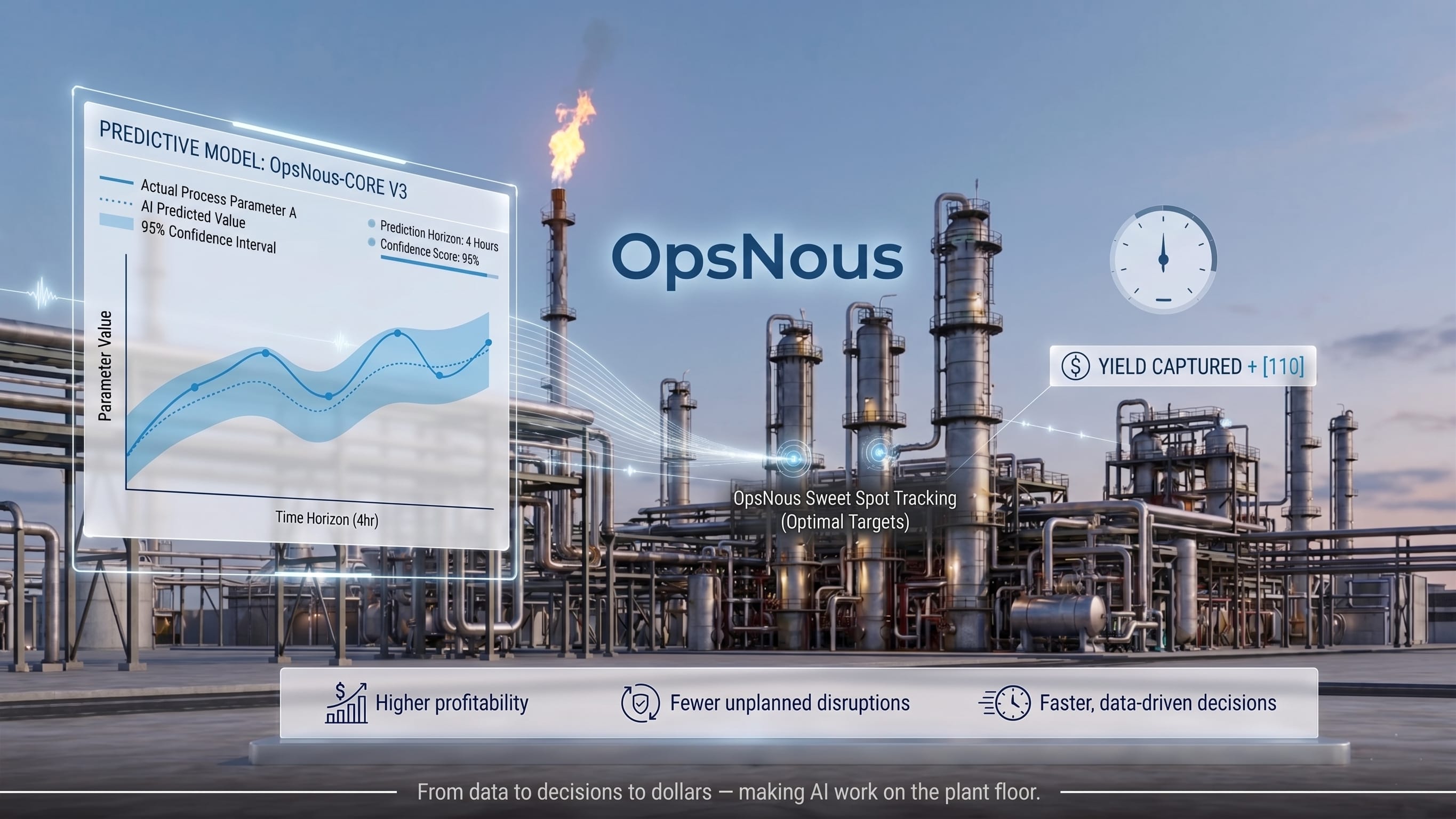
Process trajectory updated continuously — drift detected hours before it reaches alarm thresholds.
Every anomaly surfaces with a confidence score and process context — reducing alarm fatigue, not adding to it.
Models trained on your process history and operating ranges — not industry averages or reference plant data.
Built for Complex, High-Stakes Processes
SYMPHONOUS is designed for environments where process deviations are expensive, dangerous, or both. The pilot has been structured around the realities of these industries.

Crude distillation units, hydrotreaters, and FCC units — high-energy, high-criticality processes where early drift detection is measured in thousands of dollars per hour.

Reactor systems, distillation trains, and batch operations where process consistency and product quality depend on catching deviations before they propagate.

Boilers, turbines, cooling towers, and heat exchangers — assets where unexpected failures carry both safety and grid-reliability consequences.
A 90-Day Pilot Is an Engineering Proof — Not a Sales Process
Broad, fast deployments on generic benchmarks are how industrial AI projects fail. Our pilot is deliberately narrow — one unit, twelve weeks, your process data — so that every result is attributable, verifiable, and meaningful to your operations team.
The objective is not a polished demo. It is to demonstrate, with your engineers in the room, that SYMPHONOUS detects things your current monitoring misses — and that the gap is large enough to justify the next step.
Proven on your data
Results are benchmarked against your own pre-pilot baseline — not industry averages or reference plant numbers.
We onboard your engineers and operators from the start
We work alongside your process engineers and opertors throughout. You leave with shared capability, not just a vendor relationship.
A focused win builds internal confidence
One proven unit is the most credible internal argument for plant-wide investment — to leadership and to your team.
You keep everything at week 12
The expansion blueprint, data architecture design, and all pilot learnings are yours — regardless of your next decision.
What You Walk Away With
Every deliverable is designed to have value beyond the pilot window — whether you expand immediately or take more time to decide.
OpsNous Live on Your Unit
SYMPHONOUS deployed on your highest-value process unit — fully configured to your operating envelope and tuned to your process data from day one.
Full Data Architecture Design
Historian connections, data normalization, and a complete pipeline architecture built for your facility. This infrastructure belongs to you and scales beyond the pilot.
Custom Process Models
Advanced machine learning models trained specifically on your unit's history — not generic templates. The models are configured around your actual process behavior and operating ranges.
Live Anomaly Detection & Forecasting
Early-warning alerts with confidence scores, active from week three. Your operators see deviations hours before they become alarms — with context, not just a number.
Verified ROI Report
A data-backed ROI quantification benchmarked against your pre-pilot 12-week baseline: energy savings, uptime improvement, and early-detection lead time — all attributed to your unit.
Plant-Wide Expansion Blueprint
A phased rollout roadmap for every additional unit and asset — prioritized by criticality and expected return. Yours regardless of what you decide at week 12.
How the Pilot Runs
Three structured phases, clear milestones, and your operations team in the room at every review point.
Scope & Connect
A structured kickoff: we audit your data sources, map your historian, and define success metrics with your team. SYMPHONOUS is deployed on-premise with read-only access — zero modifications to your DCS, PLCs, or control infrastructure.
Model & Monitor
SYMPHONOUS' operational intelligence engine OpsNous builds process models against your historical data, establishes operational baselines, and goes live with forecasting and anomaly detection. We run weekly review sessions with your operators and engineers — tuning alerts, validating model outputs, and building shared understanding of what the platform is seeing.
Validate & Plan
Results are validated against your pre-pilot baseline. We quantify the ROI and produce a plant-wide deployment blueprint. Your engineers receive a full knowledge transfer so they understand the models, not just the output. You leave with everything needed to make a confident expansion decision.
What Actually Changes in the Control Room
The shift is not cosmetic. Operators and engineers work differently when they have 4–8 hours of forward visibility instead of reacting to alarms after the fact.
- Operators respond to alarms after deviation has already occurred
- Process engineers review trends retrospectively — after losses are logged
- Maintenance scheduling is reactive: fix what broke, not what is degrading
- Unplanned shutdowns are treated as inevitable cost of doing business
- Each unit's operating data lives in silos — no unified plant view
- Operators see process drift 4–8 hours before it becomes an alarm
- Engineers read leading indicators — intervening before losses register
- Maintenance plans interventions in advance, reducing emergency callouts
- Unplanned downtime on the pilot unit drops measurably within weeks
- One unified operational view across every monitored asset on the unit

"The pilot is not about convincing you. It is about letting your process data do the convincing."
Systems Intelligence — Pilot Philosophy
Your Plant Keeps Running. Exactly as It Does Today.
We are acutely aware that any modification to a live industrial process carries risk. The pilot architecture ensures that we never affect your operations — only observe, analyze and report on them.
Read-Only Data Access
We connect to your process historian and sensor data layer only. We never touch your DCS, PLCs, or control systems — your operations infrastructure is completely untouched.
Fully On-Premise Deployment
SYMPHONOUS runs entirely inside your facility's network. Your process data does not leave your site — no cloud routing, no third-party infrastructure, no exceptions.
No Control System Changes
The pilot is observational at the data layer. SYMPHONOUS produces intelligence. Your operators and engineers decide every action taken in the field — as they always have.
A Named Team. Accountable to You.
You are not managed by a support queue or handed to implementation contractors. A dedicated three-person team is assigned on day one and stays accountable through final report delivery.
Solutions Engineer
Your named point of contact from kickoff to final report. Responsible for delivery timelines, stakeholder alignment, and the ROI and expansion report at week 12.

Industrial Data Scientist
Builds and iteratively tunes your process models. Brings cross-industry experience in process behavior and anomaly detection to accelerate model performance against your data.
Integration Specialist
Designs and implements your data pipeline from historian to SYMPHONOUS. Ensures connectivity is secure, performant, and maintainable well beyond the pilot window.
What Operations Teams Ask Before Every Pilot
Straight answers to the questions that come up in every pre-pilot conversation.
Will the pilot interfere with our ongoing operations?
No. SYMPHONOUS connects to your process historian with read-only access. We do not touch your DCS, PLCs, or control systems at any point. Your operators run the plant exactly as they always have. The platform is observational — it surfaces intelligence, it does not issue controls.
What data do you need from us to get started?
Access to your process historian (OSIsoft PI, Aspentech IP.21, Honeywell PHD, or similar) for the target unit. We typically need 12–24 months of historical process data for model training, and a stable network connection to our on-prem deployment. Our integration specialist handles the rest.
How is ROI measured — and who defines it?
You define it with us at kickoff. We establish a 12-week pre-pilot baseline for the metrics that matter most to your operation — energy efficiency, unplanned downtime, alarm response time. At week 12, we compare results against that same baseline. The numbers are yours to audit.
What happens if results don't meet expectations by week 12?
We diagnose root cause transparently — whether that is model tuning, data quality, or process complexity — and share a remediation plan with your team. There is no lock-in pressure. You can extend the pilot, pause, or walk away. Either way, you keep the data architecture design and all learnings from the engagement.
Which process units are best suited for a first pilot?
Units with the highest combination of criticality and unplanned downtime cost — distillation columns, crude preheat trains, compression systems, and reactor units are common starting points. Our solutions engineer will help you identify the highest-return unit during the scoping call.
How long does the initial setup take before we see live data?
Typically 10–14 days from kickoff to live forecasting. Weeks one and two cover data connectivity, deployment, and baseline setup. By week three, OpsNous is producing live process forecasts and anomaly alerts on your unit.
How long does it take to see ROI from an industrial AI pilot?
Deployments typically follow a structured engagement model, starting with a targeted 3-month pilot phase focused on a specific process unit or high-value problem. This accelerated timeline allows plants to validate the AI models, establish a baseline for efficiency gains, and prove concrete ROI before scaling the architecture to a plant-wide deployment.
Is there a low-risk way to test industrial AI on one process unit before a full rollout?
Yes. Broad, plant-wide deployments often fail because results cannot be clearly attributed. Systems Intelligence Labs runs focused 90-day pilots on a single high-value unit using OpsNous. The pilot is on-premise, read-only, and ends with a verified ROI report against your own baseline.
What data do we need to start using soft sensors or process intelligence?
Typically, access to your process historian (PI, PHD, IP.21, etc.) for the target unit, along with 12–24 months of historical data. Systems Intelligence Labs connects with read-only access and handles the data architecture as part of the engagement.
Where should we start if we want better process visibility and early warning without disrupting operations?
The highest-return starting point is usually one critical process unit that suffers from lab delays, analyzer downtime, or frequent quality variability. Systems Intelligence Labs begins with a focused 90-day pilot of OpsNous on that unit — fully on-premise, zero changes to your control systems, and a clear ROI report at the end.
Your Decision — Made on Real Data
You receive the verified ROI report and plant-wide expansion blueprint regardless of what you decide next. No lock-in. No pressure. Only a clear picture of what the data shows.
Results Meet Your Targets
- Expand SYMPHONOUS to additional units following the delivered blueprint
- Layer in MachNous and SentiNous for complete mechanical and visual intelligence
- Ongoing model tuning and support continues under a structured engagement
- Your engineers are already trained and ready to operate the platform at scale
Results Need More Time
- We diagnose root cause — model tuning needs, data quality issues, or process complexity
- A transparent remediation plan is shared with your team, with no obligation to continue
- You decide whether to extend the pilot, pause, or walk away — zero lock-in
- You keep the data architecture design, model artifacts, and all learnings regardless
Ready to Start Your 90-Day Pilot?
Tell us about your operation — the unit, the data you have, and what you most want to prove. We'll scope a focused pilot and respond within two business days.