
OpsNous
Makes your shift easier and your plant more profitable.
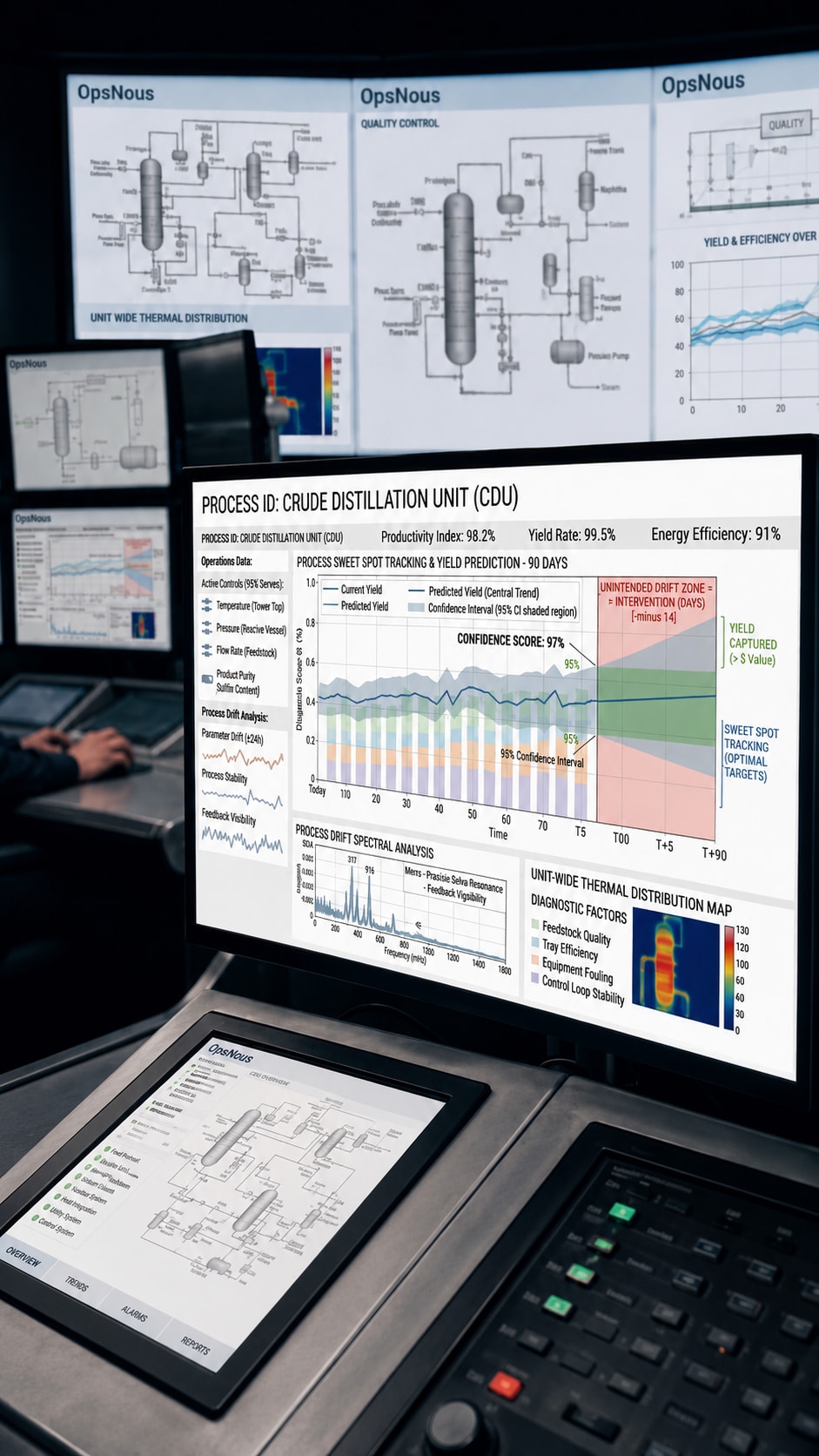
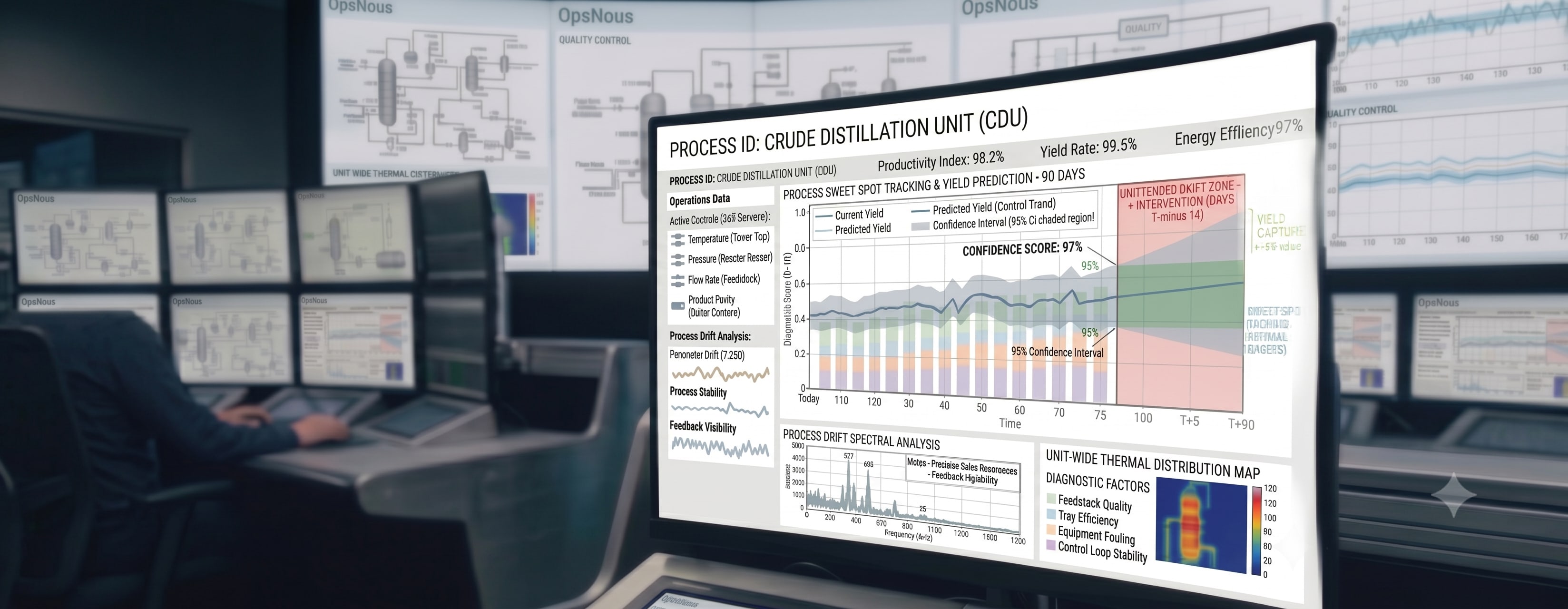
OpsNous is an intelligent assistant that serves as your plant's nerve center. By ingesting real-time data from thousands of sensors, it translates raw telemetry into prioritized, actionable insights. Operators gain a single pane of glass with smart alerting that cuts through the noise — eliminating guesswork and ensuring the facility runs at its absolute best.
What OpsNous Delivers
Connects with multitude of plant data sources and ingests real-time data with lowest possible latency
Creates, recommends and deploys hundreds of process data models in point and click fashion
Realizes full process entitlement by contiously monitoring your entire plant for optimization
Continously watches for process faults and dianoses underlying causes
From Data to Decision
Build Process Models
You know your plant; OpsNous knows your data.
- Rapid Modeling: intuitively builds several process-specific ML models.
- Smart Predictions: automatically tests and recommends the best-performing model for your operations.
Monitor Process Drifts
Once deployed, OpsNous acts as highly accurate soft-sensors that continuously analyze live data to:
- Detect drift early: catch subtle anomalies long before traditional DCS alarms trigger.
- Control variance: maintain tight process control without false-alert fatigue.
Identify Underlying Causes
When a deviation is detected, OpsNous instantly pinpoints the root cause by:
- Isolating the specific sensor tags driving the anomaly.
- Providing targeted intelligence to stabilize operations and prevent downtime.
Why Teams Run OpsNous
Stay in the Sweet Spot, All the Time
OpsNous constantly monitors your data and projects process trajectories so you can:
- Catch tiny shifts early — detect temperature or pressure changes before they cause issues.
- Adjust smoothly with the heads-up needed to maintain peak unit efficiency.
Stop Leaving Money on the Table
OpsNous closes the gap between actual and optimal plant performance:
- Eliminate conservative running — gain the foresight to safely tighten control targets.
- Maximize yield by capturing hidden "process entitlement" and extracting full value from your feed.
Real Savings, Shift After Shift
OpsNous turns optimized operations into direct financial savings by:
- Preventing sudden, costly process upsets.
- Reducing excess fuel and steam consumption.
- Maximizing on-spec product output.
Impact Across the Process Industries
Flare Event Reduction
OpsNous allows refineries to correlate upstream unit upsets with downstream flaring events — reducing unplanned flare hours.
Alarm Rationalisation
OpsNous significantly cuts nuisance alarms in a batch chemicals plant, freeing operators to respond faster to genuine process deviations.
Turbine Health Monitoring
OpsNous provides control room operators unit-level visibility across a the turbine fleet, reducing response time to temperature excursions appreciably.
Measurable Results, Not Promises
OpsNous — Frequently Asked Questions
What is a soft sensor, and why use it instead of a physical analyzer?
How can we stop waiting hours for lab results before knowing if the product is on-spec?
What should we do when our online analyzer is down for calibration or maintenance?
How do we reduce off-spec product during grade transitions?
How can we detect process drifts before traditional alarms fire?
Is there a way to get continuous product quality measurement without buying expensive online analyzers?
Our soft sensors lose accuracy after a few months. How do you keep them reliable?
How do we reduce nuisance alarms and alarm fatigue in the control room?
We still run the plant more conservatively than necessary because we don't fully trust the measurements. How can we tighten control safely?
How can we get early warning of abnormal batches in polymerization or specialty chemical processes?
What is the difference between a soft sensor and a traditional online analyzer?
How do we reduce unplanned flare events in refining and petrochemical plants?
Can soft sensors work in harsh environments where physical sensors fail (e.g. cement kilns or high-temperature reactors)?
How do we stop engineers from spending hours manually reconciling lab data with historian trends?
See OpsNous on your data
Book a technical walkthrough and we'll map it to your existing OT/IT systems.