

Process Automation
Foresight-Driven Action Across Your Entire Facility
Static Automation is Not Intelligence
Automation becomes valuable when it is connected to live operational context, not when it simply executes pre-defined rules in isolation. Static control loops cannot anticipate process deviations before they cascade.
How Process Automation Stabilizes Your Yield
Bridging operational intelligence with closed-loop controls to orchestrate safety and efficiency.
Operational Workflow Automation
Eliminate manual operational handovers. We map setpoint recommendations directly to automation networks, removing delay bottlenecks between anomaly detection and setpoint corrections.
Connected Plant Systems
Solder control nodes, maintenance notifications and raw telemetry under a single unified intelligence umbrella, ensuring that every valve behaves in alignment with plant-wide yield targets.
Intelligent Process Orchestration
Deploy smart setpoint controllers that continuously adapt to downstream constraints, balancing mass and energy balances dynamically without relying on static preset variables.
Adaptive Operational Control
Build air-gapped secure automation paths that act on validated predictive recommendations, creating a self-healing operational loop that mitigates failures automatically.
Phased Automation Execution
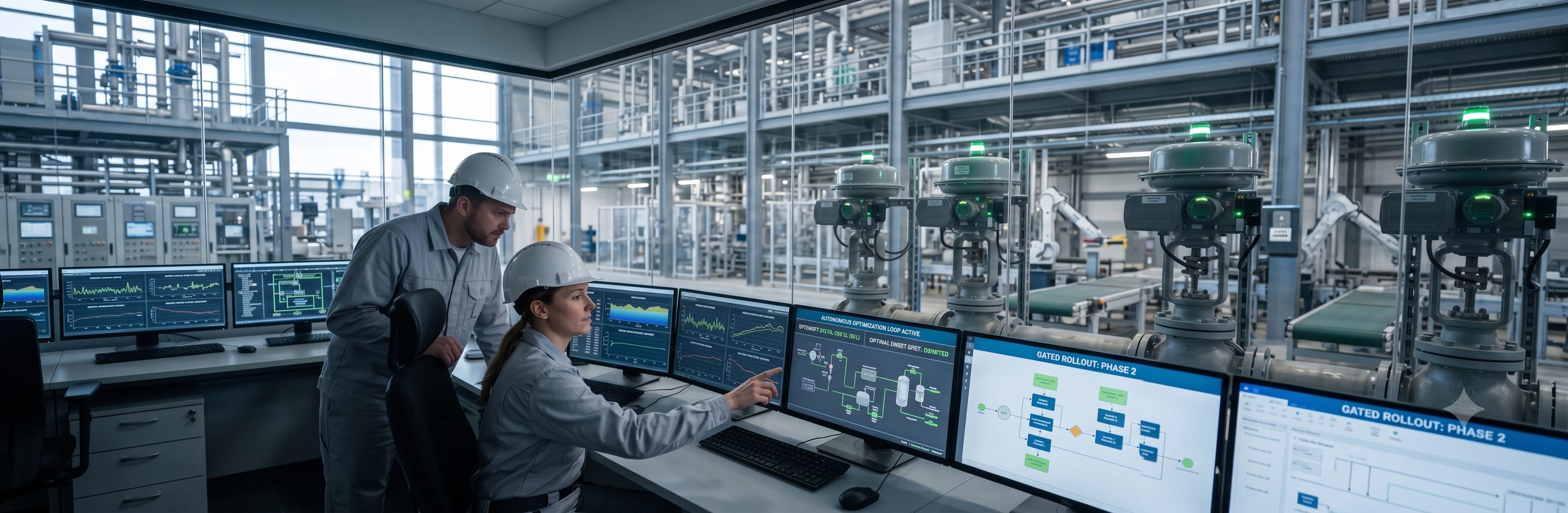
Bridging the physical plant and the digital controllers requires a systematic rollout protocol, validating safety locks at every phase.
Direct recommendation setpoint links
Map recommendations directly to DCS.
Siloed valve target safety locks
Lock downstream variables within absolute hard-coded operating ranges.
Self-healing loop auto-recovery
Enable control loops to revert to manual safety overrides under communication fault.
Signals & Workflow Extraction
Map standard operating procedures and manual valve adjustment targets from historic DCS logs.
Closed-Loop Simulator Tuning
Calibrate neural setpoint recommendation boundaries under simulated process upsets.
DCS Setpoint Recommendations
Connect recommendation channels to DCS controllers.
Act on Predictive Foresight, Automatically
Talk to our engineers about closing the loop between prediction and action on your process units.