

Soft Sensors
How to Reduce Laboratory Delays in Process Plants Using Soft Sensors
BlogSoft Sensors09 min readOctober 10, 2026
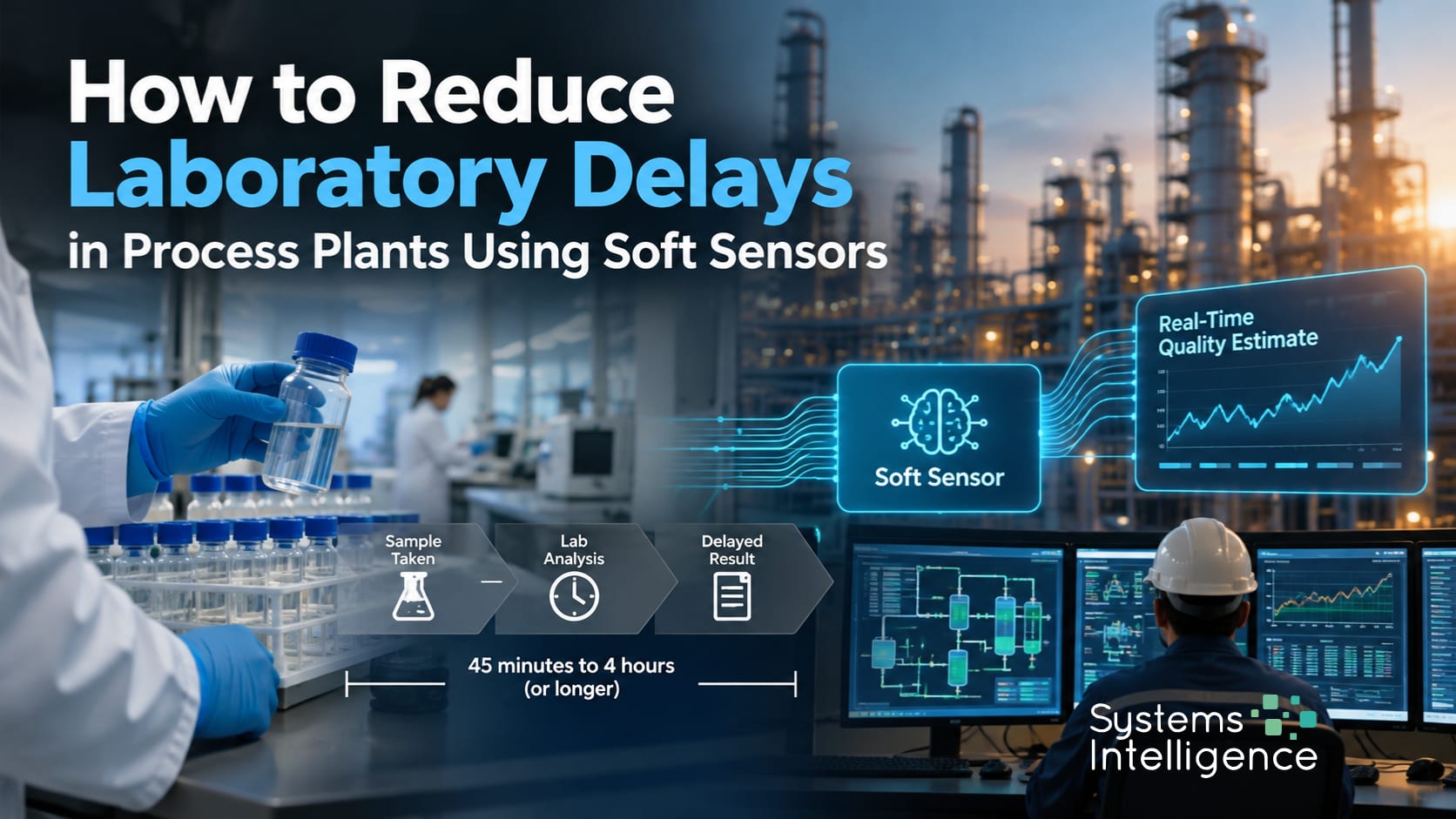
Most process plants still wait hours for laboratory results before knowing if the product is on-spec. Soft sensors close that gap by continuously estimating critical quality variables from the data the plant already collects — giving operators real-time visibility instead of delayed feedback.
How to Reduce Laboratory Delays in Process Plants Using Soft Sensors
Every process plant lives with a quiet but expensive problem: the laboratory delay.
A sample is taken. It travels to the lab. It waits in a queue. It is prepared, analyzed, and the result is finally entered into the system. By the time the number reaches the control room, the process has already moved on. In many plants this delay stretches from 45 minutes to four hours — sometimes longer.
During that window, operators are effectively flying blind on the variables that matter most: composition, melt index, purity, free lime, moisture, or critical quality attributes. They make decisions based on the last known good value or on secondary indicators that only loosely correlate with the real quality. The result is familiar — conservative setpoints, excess energy use, off-spec product during transitions, and a constant low-level anxiety that something may already be drifting out of specification.
This is not a new problem. It is one of the oldest constraints in continuous and batch process industries. What has changed is that we now have a practical, proven way to close much of that gap: soft sensors.
The Real Cost of Laboratory Delay
Laboratory delay is not just an inconvenience. It has measurable operational and financial consequences.
When quality feedback arrives late, plants respond in predictable ways:
Operators run further from constraints than necessary because they lack confidence in the current state.
Advanced Process Control applications are detuned or limited because the feedback loop contains too much dead time.
Grade transitions take longer and produce more off-spec material.
Online analyzers become single points of failure. When they go down for calibration or maintenance, the plant loses its only near-real-time quality signal.
Engineers spend hours reconciling historian trends with delayed lab results after the fact, instead of intervening while the process is still recoverable.
In high-value processes — polymers, specialty chemicals, refining, cement, pharmaceuticals — these effects compound quickly. A few hours of delayed visibility can translate into significant yield loss, energy waste, or reprocessing costs.
The traditional response has been to install more online analyzers. While analyzers are valuable, they bring their own limitations: high capital cost, ongoing maintenance, calibration requirements, and vulnerability in harsh process environments. They also cannot be installed everywhere. Some measurements remain fundamentally difficult or expensive to obtain continuously with physical instruments.
This is exactly where soft sensors become powerful.
What Soft Sensors Actually Do
A soft sensor is a real-time software model that estimates a hard-to-measure variable using the high-frequency measurements the plant already collects — temperatures, pressures, flows, valve positions, motor currents, spectroscopic signals, and other readily available tags.
Instead of waiting for the laboratory, the soft sensor continuously calculates an estimate of the target quality variable at the frequency of the underlying process data, often every few seconds.
Mathematically, it constructs a mapping between the fast measurements and the slow or missing quality variable. Once validated, that mapping runs online and provides operators and control systems with a continuous quality signal.
Soft sensors do not replace laboratories. Laboratories remain essential for calibration, validation, and regulatory purposes. What soft sensors do is fill the long gaps between laboratory results with reliable, high-frequency estimates.
Why Laboratory Delay Persists — and Why Soft Sensors Can Break It
Three structural reasons explain why laboratory delay has been so persistent:
Physical measurement limits
Some quality attributes cannot be measured continuously with existing hardware at acceptable cost or reliability.Sampling and logistics reality
Even when online analyzers exist, many plants still rely on grab samples for critical checks. Sample transport, preparation, and analysis create inherent delay.Trust and maintenance burden
Plants are reluctant to rely on models they do not understand or that degrade over time. Early soft-sensor projects often failed because models were static and lost accuracy as the process drifted.
Modern soft-sensor approaches address all three issues. Hybrid and physics-informed models combine process knowledge with data-driven learning. Continuous performance monitoring against laboratory results keeps the models honest. And the best implementations are designed to work inside the existing plant architecture without disrupting control systems.
How Soft Sensors Reduce Laboratory Delay in Practice
The impact is most visible in four common situations.
1. Continuous Quality Visibility Between Lab Samples
Instead of a quality chart that updates only a few times per shift, operators see a continuous trend. This alone changes decision-making. Small drifts become visible early. Corrections can be made while the process is still close to target.
2. Backup During Analyzer Downtime
When a physical analyzer is offline, the soft sensor continues to provide an estimate. Control loops no longer need to drop to manual or freeze the last value. This is one of the highest-ROI applications of soft sensors.
3. Faster Grade Transitions
During transitions, quality is changing rapidly. Laboratory samples arrive too late to guide the move. Soft sensors give a live view of the trajectory, allowing operators and APC systems to complete the transition with less off-spec material.
4. Tighter, Safer Operation
With continuous quality estimates and clear confidence indicators, plants can safely reduce the conservative buffers they previously maintained. The result is higher yield, lower energy consumption, and better process entitlement.
The Practical Challenges — and How They Are Solved
Soft sensors are not magic. Several real engineering challenges must be handled correctly.
Model Drift
Process plants change. Heat exchangers foul, catalysts deactivate, and operating conditions shift. A model trained after a turnaround will gradually lose accuracy if it is left static.
Modern systems monitor prediction error against reconciled laboratory results and adapt the models over time.
Multi-Rate Data
Process data arrives every second. Laboratory results arrive every few hours. Simply aligning the timestamps incorrectly destroys model quality. Proper soft-sensor platforms handle multi-rate data carefully and use semi-supervised techniques that learn process dynamics from the abundant high-frequency data while updating against sparse laboratory labels.
Trust and Explainability
Operators will not act on a number they do not understand. Good soft-sensor systems show which sensors are driving the estimate and provide uncertainty measures so the system can flag when it is operating outside its reliable range.
Deployment Without Risk
Plants cannot afford experiments that touch the DCS or control systems. The safest implementations run on-premise with read-only access to the historian and leave all control decisions with the existing operators and APC systems.
How Systems Intelligence Labs Approaches the Problem
At Systems Intelligence Labs we treat laboratory delay as one of the highest-leverage problems in process operations. Our approach is built around OpsNous, the operations intelligence engine inside the SYMPHONOUS platform.
OpsNous is designed specifically to turn existing plant data into continuous soft-sensor estimates and early process drift detection. It connects to the historian with read-only access, builds process models rapidly, monitors for drift, and surfaces estimates and alerts with context rather than additional noise.
We deliberately start with a focused 90-day pilot on a single high-value unit. The pilot is structured as an engineering proof, not a sales exercise:
One critical process unit
On-premise deployment inside your network
Read-only historian access — zero changes to DCS or control systems
Models trained on your actual process history
Live soft-sensor estimates and drift detection from week three
Verified ROI report against your own pre-pilot baseline
Full knowledge transfer so your engineers understand the models
The goal is simple: put continuous quality visibility in front of your operators and engineers, quantify the difference, and leave you with everything needed to decide on expansion.
This approach has been applied in environments where laboratory delays and analyzer limitations create clear operational pain — including chemical manufacturing, polymerization, and other continuous process units where real-time quality estimates directly affect yield and consistency.
What Changes in the Control Room
When laboratory delay is reduced through soft sensors, the daily work of operators and engineers shifts.
Instead of waiting for the next lab result and then reacting, teams see the quality trajectory in real time. Small deviations are corrected early. Transitions become smoother. Analyzer outages no longer force the plant into manual mode. Engineers spend less time reconciling delayed data and more time improving the process.
The plant does not become fully autonomous overnight. What changes is the quality of information available for human and automated decisions. That information advantage compounds over every shift.
Getting Started Without Unnecessary Risk
The highest-return starting point is usually obvious once you look at the data: a quality variable that currently suffers from long laboratory delays or frequent analyzer downtime, on a unit where off-spec product or energy waste has measurable cost.
From there, the path is straightforward. Connect to the existing historian. Build and validate the soft sensors on historical data. Deploy them in parallel with current operations. Measure the difference against a clear baseline. Decide on next steps with real evidence.
Laboratory delay is one of the few persistent constraints in process plants that can now be materially reduced with technology that works inside existing infrastructure. Soft sensors do not eliminate the laboratory. They make the laboratory’s results far more powerful by filling the long gaps between samples with continuous, trustworthy estimates.
For process plants still operating with multi-hour quality feedback loops, that difference is no longer optional. It is one of the clearest routes to higher yield, tighter control, and more resilient operations.
If your plant currently waits hours for critical quality results, the practical next step is to examine one high-value unit and quantify what continuous soft-sensor visibility would change. That is exactly where we begin.